Records, liens, costs and reporting
Records requests, liens and costs, kept with the case
Records requests drafted and chased, liens and costs tracked to the cent, and firm reports for the people who run the practice. All on Docket.
- This page01Case comes inintake or upload
- 02AI draftcited to pages
- 03Attorney reviewedit, approve or reject
- 04Approvedexport, demand, report
- 05Clientnever sees AI output
Included on Docket and Enterprise.
Who this is for
Paralegals and case managers who chase records and track liens, and office managers who watch costs and caseload, at personal injury firms; firm reporting serves employment firms too. The medical records requests guide covers what a complete request contains, and records requests, liens, costs and reporting are on Docket and Enterprise (pricing).
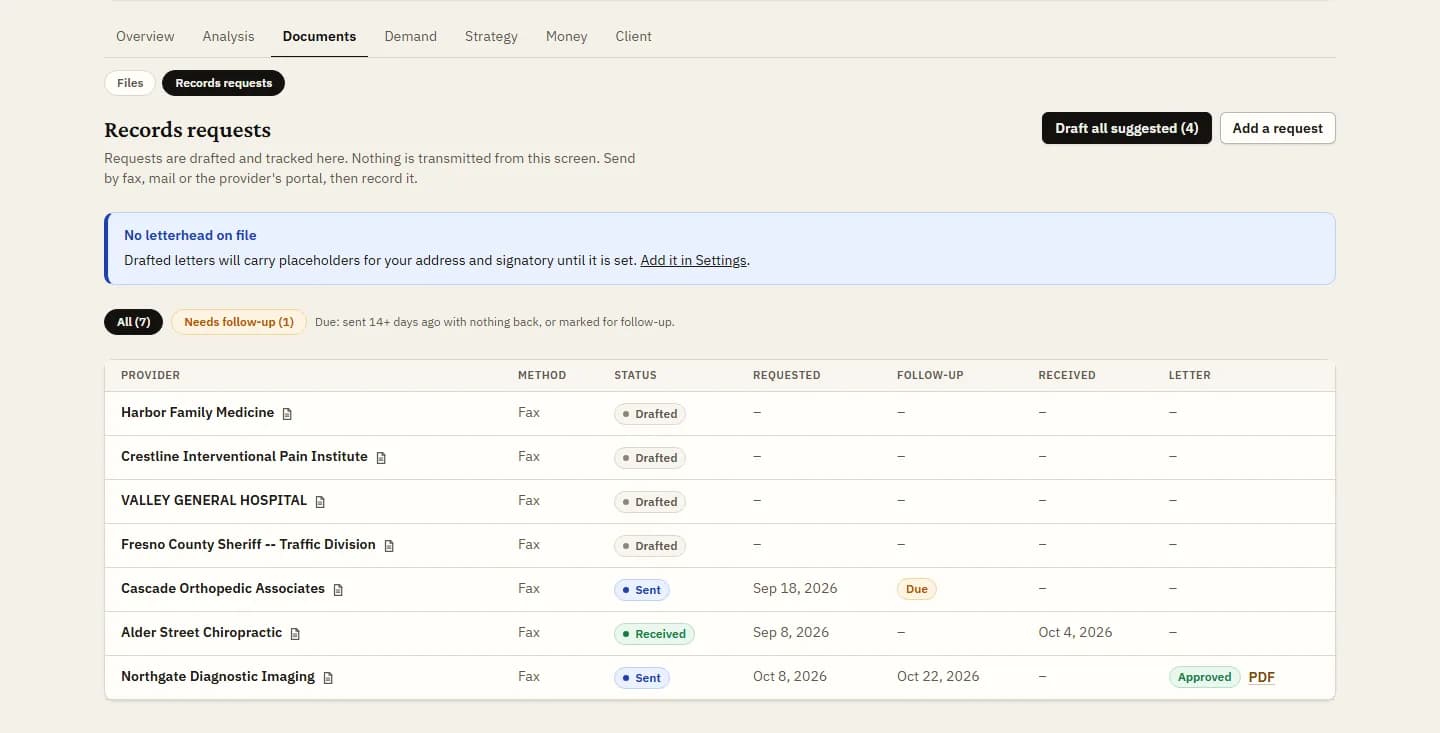
Records requests from the providers found
When Brennick reads a case, it lists the providers in the records. Each provider that holds medical records becomes a suggested request; employers, police and insurers are left out. You can add any provider by hand.
Brennick drafts the letter from the client’s name, the provider, the dates of service and your letterhead, and nothing from the analysis. A separate review then checks it: a date the drafter was not given, a missing authorization line, a 42 CFR Part 2 program that needs its own consent wording. Any bracketed placeholder, such as a date of birth, must be filled before the letter can be approved.
When the client’s signed HIPAA authorization is stored on the case, the letter encloses it and says so. When none is stored, the letter carries a placeholder asking you to confirm it is enclosed. Draft one letter, or all suggested letters in one go; letters wait until the case is accepted.
Sent by your staff, tracked by Brennick
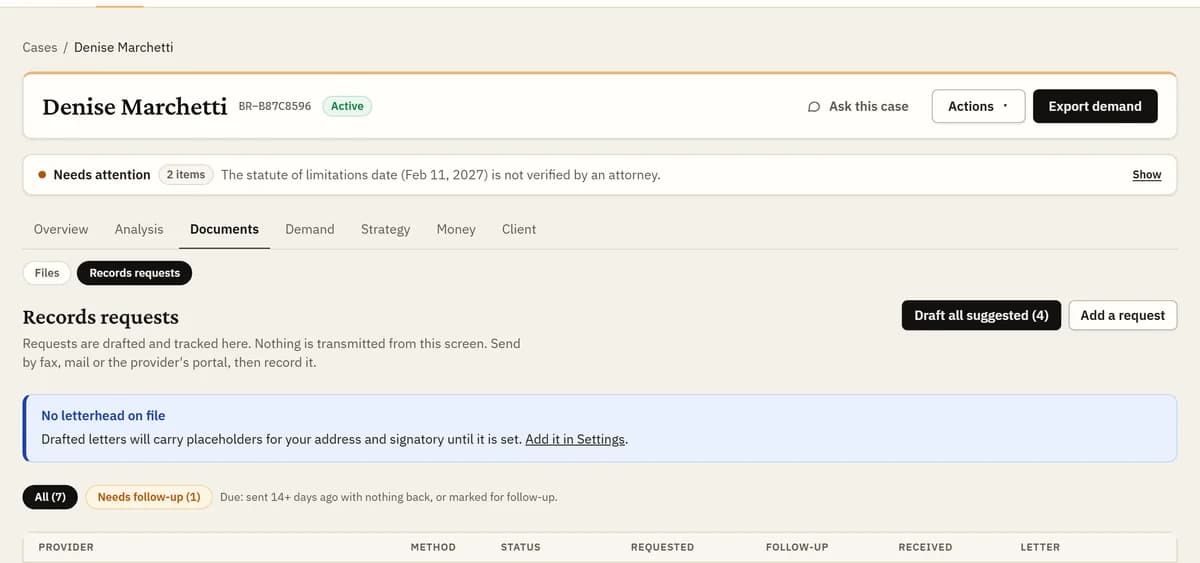
Brennick does not fax or mail anything. Your staff send the approved PDF by fax, mail or the provider’s portal and mark it sent, and the follow-up date is set 14 days later. Overdue requests appear in a firm-wide follow-up list, and a follow-up letter is drafted and approved the same way.
When the records arrive, attach them to the request. The file is read and added to the case. On a case already analyzed, its new entries wait for an attorney as new since approval, and the approved analysis is not changed. Added records never count as a new case.
Liens with stages and honest totals
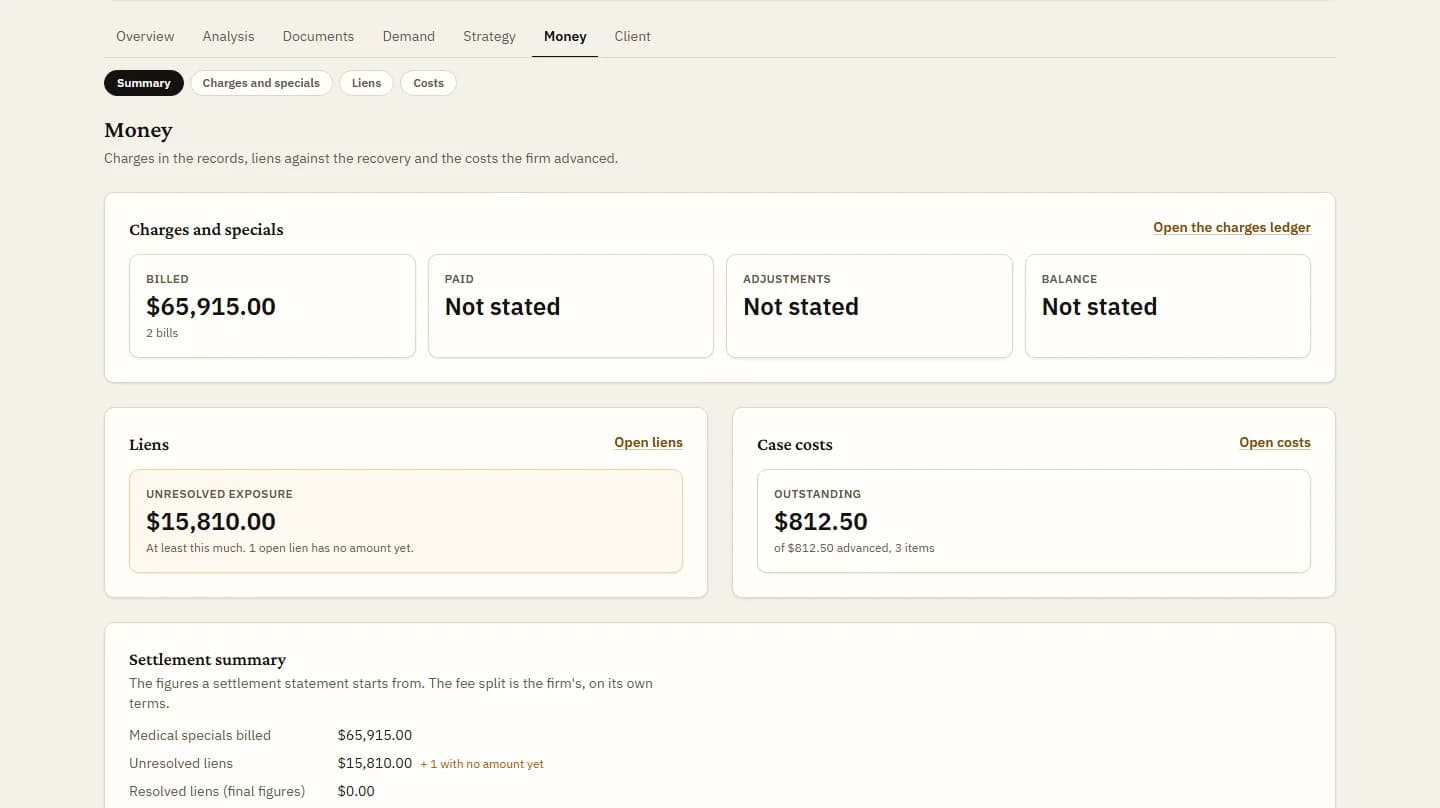
Record each lien by type: Medicare, Medicaid, ERISA plan, hospital, letter of protection or other, with the amount asserted and any negotiated figure. A lien moves through Notified, Conditional payment received, Negotiating and Resolved, and a stage can be skipped.
Exposure uses the negotiated figure where there is one, else the amount asserted. A lien with no amount yet is not counted as zero: the total reads “at least” and says how many liens have no figure.
Case costs, ready for the settlement statement
Record each cost your firm advances with its category, date, payee and check or invoice number, and mark it reimbursed when it is. Amounts are kept to the cent and never rounded.
Export a case’s costs as a CSV for whoever prepares the settlement statement. Any cell that a spreadsheet would run as a formula is neutralized first.
Firm reporting
Reports on your whole firm, over the last 30 days, 90 days, 12 months or a range you choose.
Every figure is an aggregate. Each section downloads as a CSV, and each download is written to the audit log with its section and range.
- Intake: submissions, accepted, declined, analyzed before deciding, the acceptance rate, and how clients heard about you, by category only (search, friend or family, another lawyer, advertising, a person or business). A named referrer is never shown.
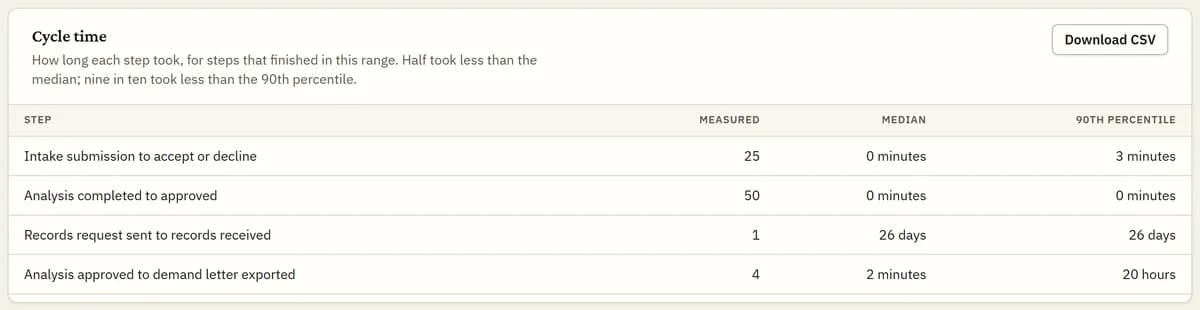
- Cycle time: the median and the 90th percentile, from submission to decision, analysis to approval, records sent to received, and approval to demand export.
- Review quality: how often attorneys edit or reject an analysis, and which sections the edits land in.
- Caseload: open cases by status, and by responsible attorney and case manager, with cases awaiting review and statute of limitations dates within 60 days.
- Statute of limitations dates: passed, within 30, 60 and 90 days, and missing, each linking to the case list.
- Money: costs advanced and outstanding, and lien exposure.
- Usage: included and extra cases each month.
FAQs
Can paralegals approve records letters?
Yes. Any staff member can approve one, once its review has run and no placeholder is left.
Does the provider learn about the injury?
No. The letter asks for records by patient, provider and dates of service. The drafter is never shown the timeline or the analysis.
What if a Medicare lien has no amount yet?
It is listed with no figure, and the exposure total reads “at least” the sum of the liens that have one.
Who sees firm reports?
Firm admins and licensed attorneys. Other staff see a sentence saying who can.
Is any of this on Brief?
No. Records requests, lien tracking, case costs and firm reporting are on Docket and Enterprise.
Keep the records chase in one place
3-day trial, 1 case, card required. Choose Docket to try records requests, liens, costs and reports.