Personal injury
Personal injury case analysis from the records, bills and dates
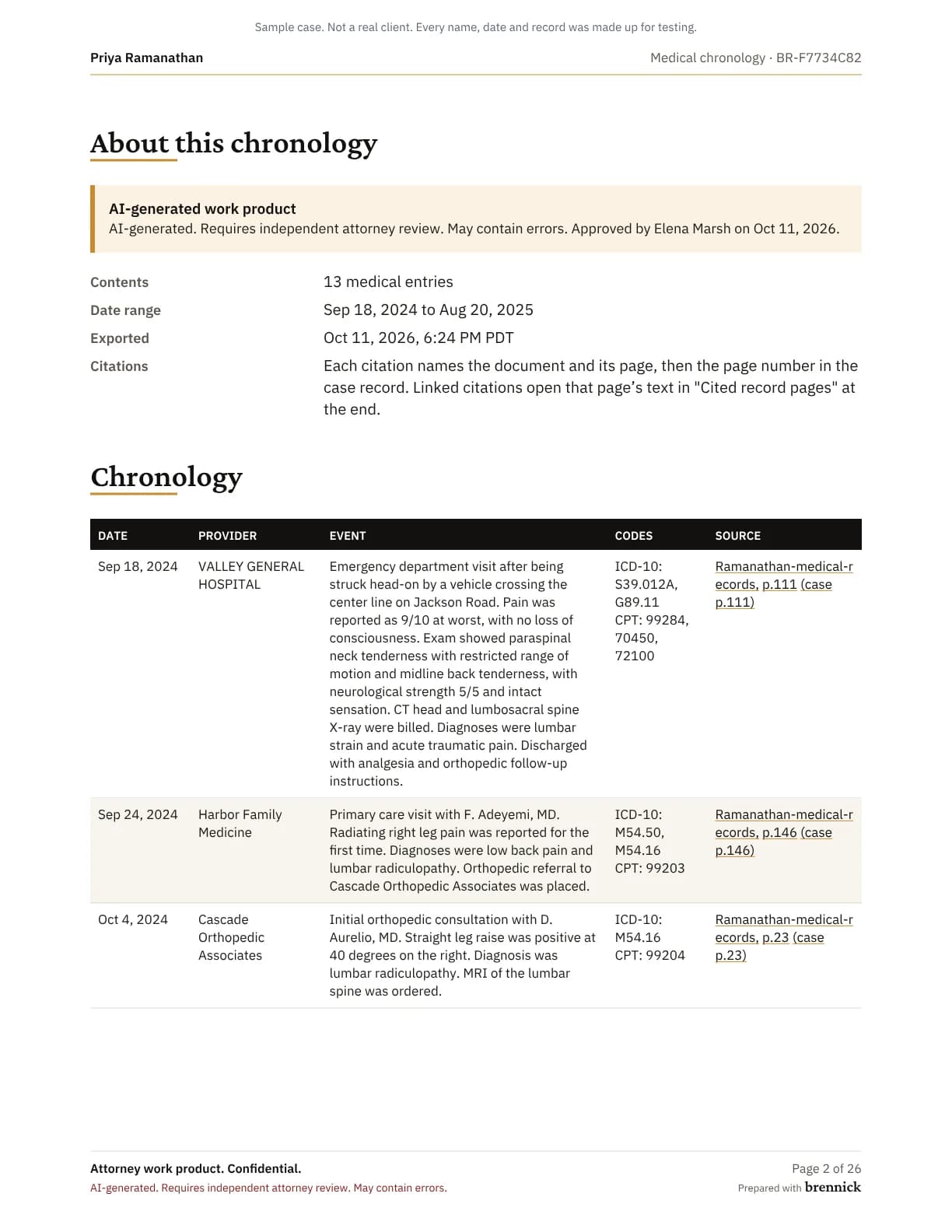
Brennick reads the records, bills and reports on an injury case and builds a medical records summary for attorneys: one timeline where the records, the bills, the police report and the insurer’s letters each cite their page. A licensed attorney at your firm reviews it before anything is used.
- 01Case comes inintake or upload
- 02AI draftcited to pages
- 03Attorney reviewedit, approve or reject
- 04Approvedexport, demand, report
- 05Clientnever sees AI output
A medical timeline your staff can check
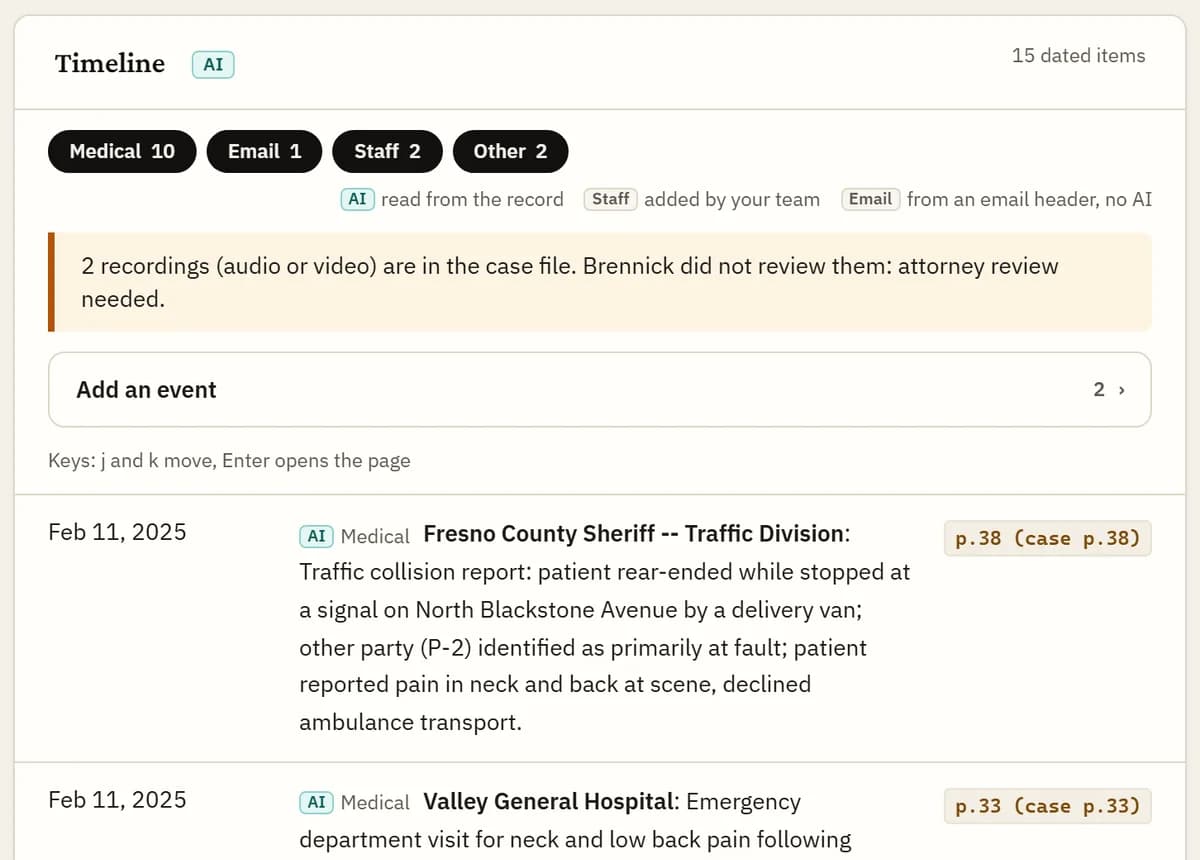
Each visit, test, procedure and discharge is a dated entry with the provider, the diagnosis and procedure codes, and the page it came from. A course of therapy is one entry listing every visit date, and each visit cites its own page when that page can be confirmed.
A police report or an insurer letter inside a records file becomes a case event beside the medical entries, not a medical entry.
Checked by code against case files where every event was known in advance: 97% of citations point to the right page, 97% of medical events were found, and 99% of visits were cited to their own page. How accuracy is measured
Gaps and missing records
Brennick measures every break of six weeks or more between dates of treatment, including breaks inside a course of therapy, and asks whether the record explains it. An explanation counts only with a quote from the record.
It also lists records the file points to but does not contain: an imaging study ordered with no result, a referral with no record from that provider, a record the file says is missing. Each finding names the page that shows it.
What it reads on an injury case
- Medical records, including scanned and faxed pages
- Itemized bills, UB-04 and CMS-1500 claim forms, and explanations of benefits
- Police and incident reports, and witness statements
- Letters and emails with insurers and the other side
- Photos, kept on the case, with any printed text in them read
- Word files, email, spreadsheets and more. Audio and video are stored for your review, not read.
A charges ledger from the bills
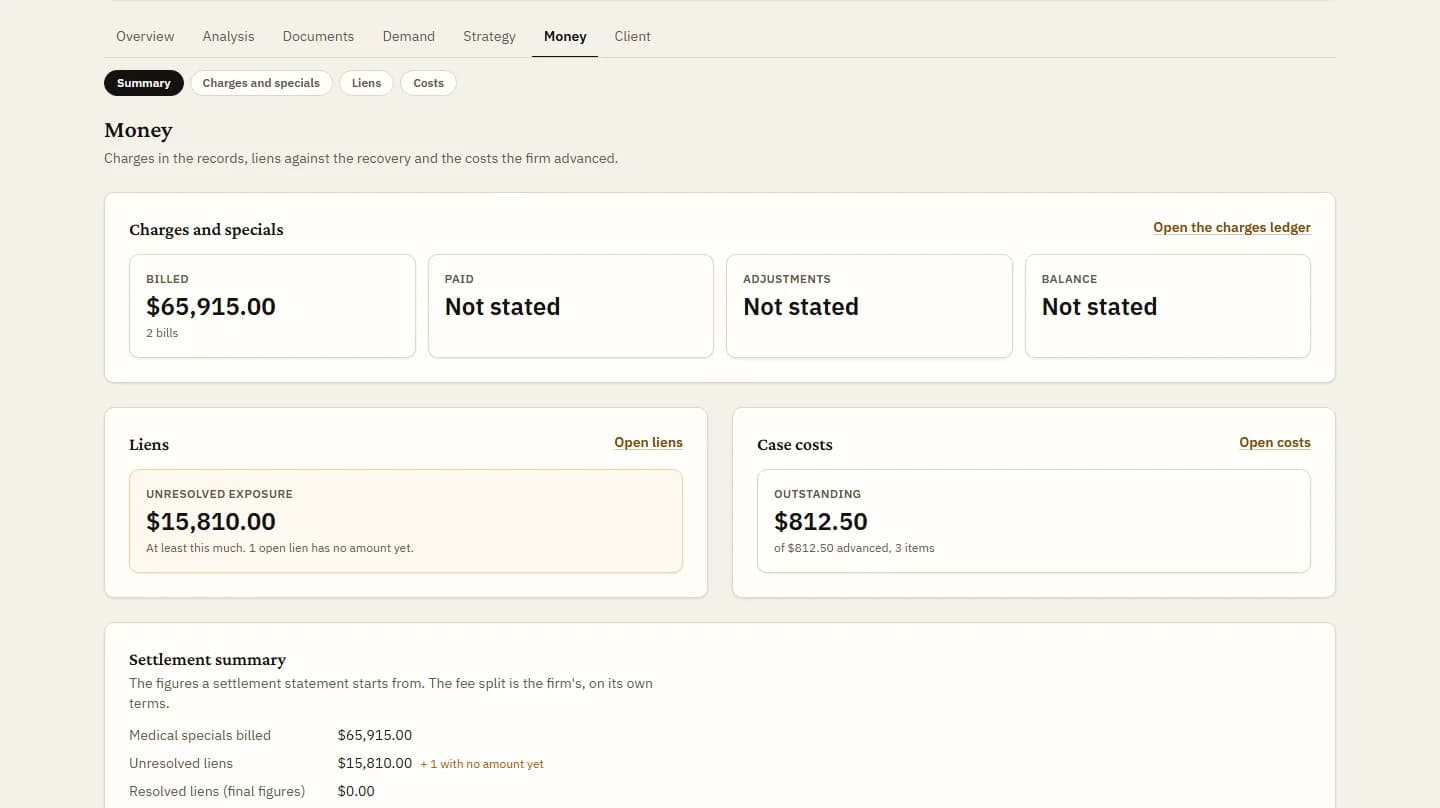
The bills become a ledger of billed, paid and balance by provider and date of service. Rules read the common bill layouts first. A billing page they cannot read goes to an AI reader, and every amount it returns must be printed on that page. Totals are added in code.
A repeated bill is marked and counted once. A figure the bill does not state reads as not stated, never as zero, and your staff can correct any row with the original kept.
Statute of limitations dates
In California, Brennick calculates the statute of limitations date for auto, premises and product liability cases from rules verified for California, and marks it unverified until an attorney verifies it. For medical malpractice and wrongful death, and in every other state, your attorney enters the date.
If a government body may be a defendant, Brennick calculates no date at all, and your attorney enters it. That is the safeguard: claims against public entities often run on a different, shorter clock. Either way, the people on the case are emailed as the date approaches.
A damages range for your attorney
With an injury and treatment in the record, Brennick gives a damages range built on a stored, cited legal basis: verified for California, and researched by AI from primary sources and labeled that way in other states, where a usable basis is found. The specials come from the charges ledger, never from the model. Workers’ compensation cases get no range.
An attorney reviews the damages estimate before anything uses it. The range, like the strength assessment, stays inside your firm, and clients never see it.
Plans
Included on every plan. Records requests and lien tracking are on Docket and Enterprise.
See pricingFAQs
Can it read scanned records?
Yes. Pages without a text layer are read with OCR and cited like any other page.
Do you calculate the statute of limitations date outside California?
No. In every other state your attorney enters it, and Brennick tracks it, emails the people on the case as it approaches and puts it on a connected calendar.
Where does the specials figure come from?
From the charges ledger: amounts printed on the bills, checked on their pages and added in code.
Is the damages range shown to the client?
Never. Clients see a plain status, their messages and their own uploads.
Check it against a file you know
3-day trial, 1 case, card required. Bring an injury case you know well and check the timeline, the gaps and the specials against it.